

To become a database developer, follow these steps:

- Learn Database Fundamentals:
- Start by understanding the basic concepts of databases, including data models, normalization, and relational algebra.
- Learn about different types of databases such as relational databases (e.g., MySQL, PostgreSQL, SQL Server) and NoSQL databases (e.g., MongoDB, Cassandra).

- Master SQL:
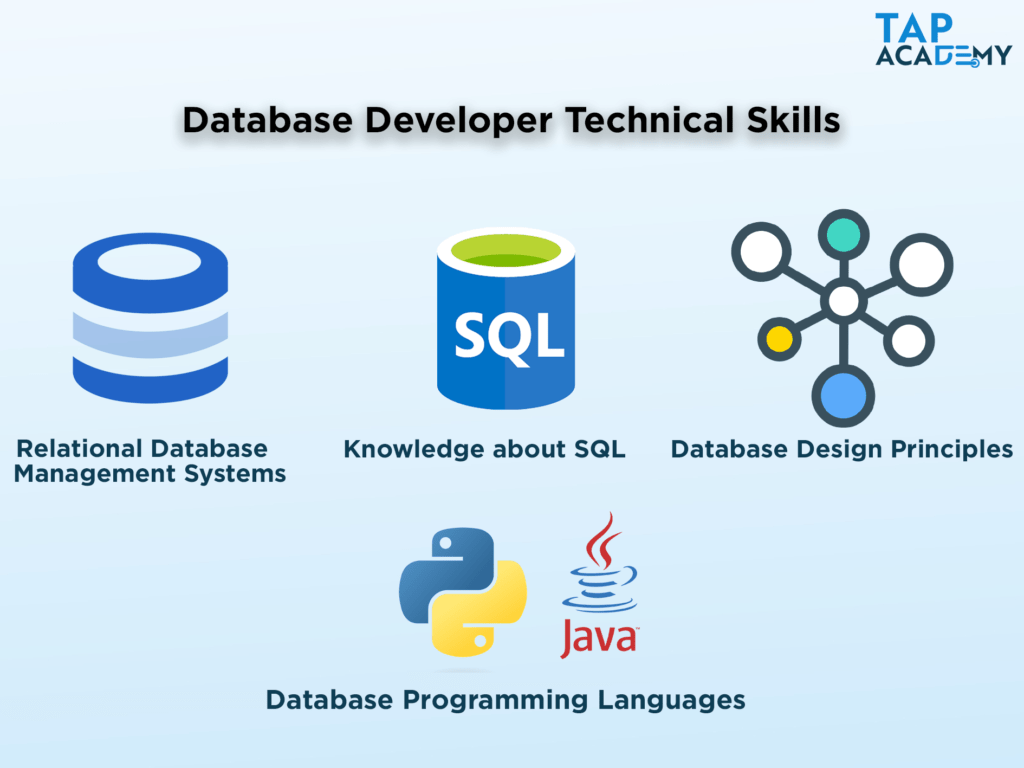
- SQL (Structured Query Language) is essential for interacting with relational databases.
- Learn SQL syntax, data manipulation (SELECT, INSERT, UPDATE, DELETE), data definition (CREATE, ALTER, DROP), and data control (GRANT, REVOKE).
- Database Design:
- Learn database design principles to create efficient and scalable database schemas.
- Understand entity-relationship diagrams (ERDs), normalization techniques, and indexing.
- Relational Database Management Systems (RDBMS):
- Gain hands-on experience with popular RDBMS like MySQL, PostgreSQL, or SQL Server.
- Learn how to install, configure, and manage databases.
- NoSQL Databases:
- Familiarize yourself with NoSQL databases like MongoDB, Cassandra, or Redis.
- Understand their data models, query languages, and use cases.
- Database Programming:
- Learn a programming language like Python, Java, or C# for database application development.
- Understand how to connect to databases, execute queries, and handle data in your chosen programming language.
- Database Administration:
- Gain knowledge of database administration tasks such as backup and recovery, security management, and performance tuning.
- Understand concepts like database normalization, denormalization, and query optimization.
- Data Warehousing and Business Intelligence (BI):
- Familiarize yourself with data warehousing concepts, ETL (Extract, Transform, Load) processes, and BI tools like Tableau or Power BI.
- Understand how to design and implement data warehouses and build reports and dashboards for data analysis.
- Continuous Learning:
- Stay updated with the latest trends, technologies, and best practices in database development through online courses, tutorials, and industry publications.
- Explore advanced topics like big data, cloud databases, and data science.
- Build Projects:
- Practice your database skills by working on real-world projects.
- Build databases, design schemas, write SQL queries, and develop database-driven applications.
- Networking:
- Engage with the database developer community by participating in forums, attending meetups, and joining online communities.
- Collaborate with other developers to learn from their experiences and share your own knowledge.
- Portfolio:
- Create a portfolio showcasing your database projects, skills, and expertise.
- Highlight your experience with different database technologies, projects you’ve worked on, and any certifications you’ve obtained.
By following these steps and continuously honing your skills through practice and learning, you can become a proficient and sought-after database developer.


 Learn4school
Leave a comment