

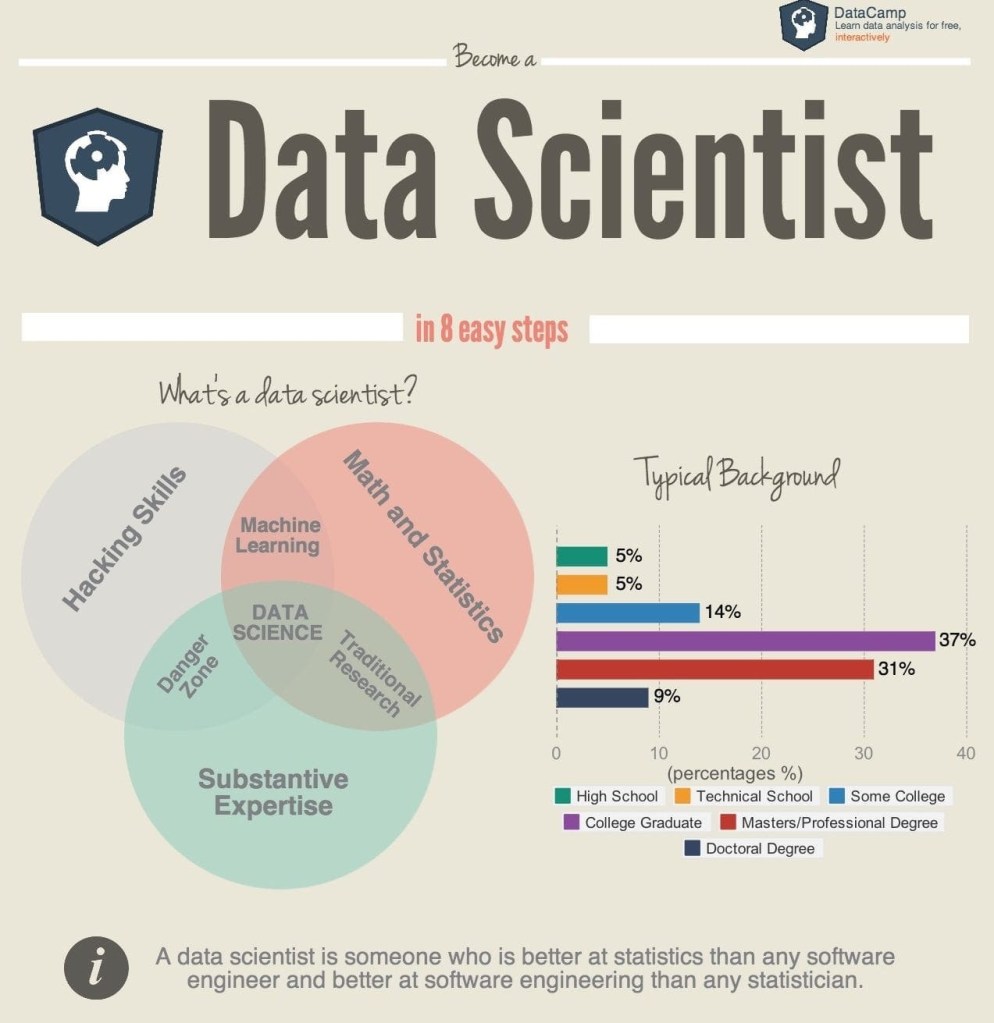
Becoming a data scientist involves a blend of education, skills development, and practical experience. Here’s a step-by-step guide:

- Educational Foundation: Obtain a bachelor’s degree in a relevant field such as computer science, mathematics, statistics, economics, or engineering. A master’s or Ph.D. can provide deeper knowledge and better job prospects.
- Learn Programming Languages: Master programming languages commonly used in data science, such as Python and R. Familiarize yourself with libraries like pandas, NumPy, scikit-learn, and TensorFlow.
- Understand Statistics and Mathematics: Develop a strong understanding of statistics, probability theory, linear algebra, calculus, and optimization techniques. These are fundamental for data analysis and modeling.
- Explore Data Analysis Tools: Learn to work with databases and data manipulation tools like SQL for querying databases, as well as data visualization tools like Matplotlib, Seaborn, and Tableau.
- Study Machine Learning and Data Mining: Dive into machine learning algorithms and techniques, including supervised and unsupervised learning, regression, classification, clustering, and dimensionality reduction.
- Practice with Real Data: Engage in projects to apply your skills and gain hands-on experience. Kaggle competitions, personal projects, and open-source contributions are great ways to build a portfolio.
- Stay Updated: Data science is a rapidly evolving field, so stay updated with the latest trends, tools, and techniques by reading books, research papers, blogs, and attending workshops, conferences, and online courses.
- Networking and Collaboration: Connect with other data scientists through online communities, forums, meetups, and conferences. Collaboration and sharing knowledge can accelerate your learning and career growth.
- Build a Portfolio: Showcase your projects, skills, and achievements through a portfolio website, GitHub repository, or LinkedIn profile. A strong portfolio can impress potential employers and demonstrate your abilities.
- Seek Internships or Entry-level Positions: Gain practical experience through internships, co-op programs, or entry-level positions in data-related roles. This will help you apply your skills in real-world scenarios and build a professional network.

Remember, becoming a data scientist requires dedication, continuous learning, and hands-on practice. Stay curious, keep exploring new ideas, and don’t be afraid to take on challenges.


 Learn4school
Leave a comment